The Codes of the Hebrew Alphabet

A study of the 22 letters, from the ancient form to the code in you

Every Hebrew letter carries a drawing, a number and a force

According to the tradition, the twenty-two letters are the language the world was made with. This book walks the alphabet from Alef to Tav to show what each letter draws, adds up to and governs. The same force can show up by its good side or by its bad side.

You don't need to know Hebrew. Every word comes with a translation and an approximate pronunciation. The road is laid out for the reader who is starting out and for the one who already studies the letters, but is still looking for an explanation they can follow and come back to.

See the offer

$9.90 USD. PDF in English, with access released as soon as your payment is confirmed.

First edition
Cover of The Codes of the Hebrew Alphabet, first edition
PDF in English, 154 pages

Meaning doesn't fit in a list

Anyone who looks up a Hebrew letter usually finds a shape, a number and a few loose words: Alef is worth 1; its ancient drawing was the head of an ox; its meanings include strength and leadership. The information is there, but the road that ties the pieces together rarely appears.

Why did an ox become a letter? What does the number 1 add to the reading? Why do words like father, truth and love begin with Alef? How can the force of beginning build something, or erase the person who helped build it?

The book answers those questions one letter at a time. Instead of handing you twenty-two separate definitions, it shows how form, number, word and application belong to the same reading. When two traditions arrive at different answers, the text says so.

Six movements for every letter

The twenty-two chapters follow the same structure. You learn where each part of the explanation sits, and you can go back to it whenever you need it.

  1. The Scene puts the force of the letter into a situation you recognize.

  2. The Form shows the ancient drawing and the construction of the script in use today.

  3. The Number explains the value and the sums it opens.

  4. The Word follows the meanings that begin with that letter.

  5. The Two Poles show what the same force builds and what it destroys.

  6. The Code in You closes the chapter with the letter in people's names and with a question for your life.

Each chapter hands the turn to the next one. The order from Alef to Tav also tells a story: the beginning, the house, the movement, the work of a person, and the end that asks what came of it.

Before you decide, read the whole chapter on Alef

This is the first letter exactly as it appears in the book. The text was not shortened or adapted for this page.

Alef, capítulo 11 of 6

Swipe to turn the page. Tap the image to enlarge it.

After Alef, Bet gives a house to what began. The book goes on like that to Tav: every letter gets a full chapter and sets up the reading of the next one.

Keep going through the 22 letters

The button takes you to the checkout. The purchase is only complete once the payment is confirmed.

Two layers, each in its own place

A Hebrew letter crossed centuries and more than one script. The book shows the letter as it appears on the Torah scrolls, in modern print and in Paleo-Hebrew, when the sign was still close to a drawing.

The concrete layer reads the pictograph: the ox head of Alef, the tent of Bet, the door of Dalet. The mystical layer reads the square script, its composition out of other letters, its numbers and the spiritual teaching of the tradition. One layer doesn't prove the other, because they were born in different ages.

When the readings converge, the book shows the convergence. When they disagree, it keeps the difference. In Heth, for example, the pictograph is a wall while the mystical reading is about life. You get both pieces of information, with no forced meeting between them.

The name comes in as an application, not a verdict

Every chapter shows what the tradition reads when that letter appears in a person's name. Once you finish the twenty-two, you can look at your own name as a sequence of forces and questions.

That reading doesn't describe a whole personality and doesn't predict the future. For names written first in the Latin alphabet, the match with the Hebrew depends on the spelling chosen in the transliteration; it isn't automatic. The letter points to a potential and a warning. The choice between the two poles still belongs to the person.

That's why the chapter on Alef doesn't end by telling you who you are. It asks what you begin, who you recognize in the story of what you built, and which way you aim the force of going first.

Where the reading comes from

Sefer Yetzirá
The claim that holds the book up: the world was made with the twenty-two letters. Quoted from the annotated translation by Aryeh Kaplan.
The oral tradition
The spiritual teaching of each letter, the way it is taught by those who keep them.
Jeff A. Benner
The reading of the ancient drawings, letter by letter.

The claim that holds the book up comes from the Sefer Yetzirá, the Book of Formation: the world was made with the twenty-two letters. The text is quoted from the annotated translation by Aryeh Kaplan, which puts different versions side by side.

The spiritual teaching of each letter comes from the oral tradition, from the way the letters are taught by those who keep them. For the ancient drawings, the book follows the work of Jeff A. Benner. A final chapter identifies the sources and records, letter by letter, the points where the readings of the pictographs don't agree.

The book doesn't ask you to accept a hidden synthesis. It tells you which layer it is using, it shows the source, and it leaves the divergence visible when there is one.

What you get

Cover of The Codes of the Hebrew Alphabet, first edition

The Codes of the Hebrew Alphabet

An ebook in English with 154 pages, laid out for reading on screen and free to print. The contents include:

  • an introduction to the alphabet as source code;
  • the explanation of the two layers and the three families of the Sefer Yetzirá;
  • twenty-two chapters, one for each letter, with the six movements;
  • a reference table of the twenty-two letters;
  • a chapter of sources and divergences.
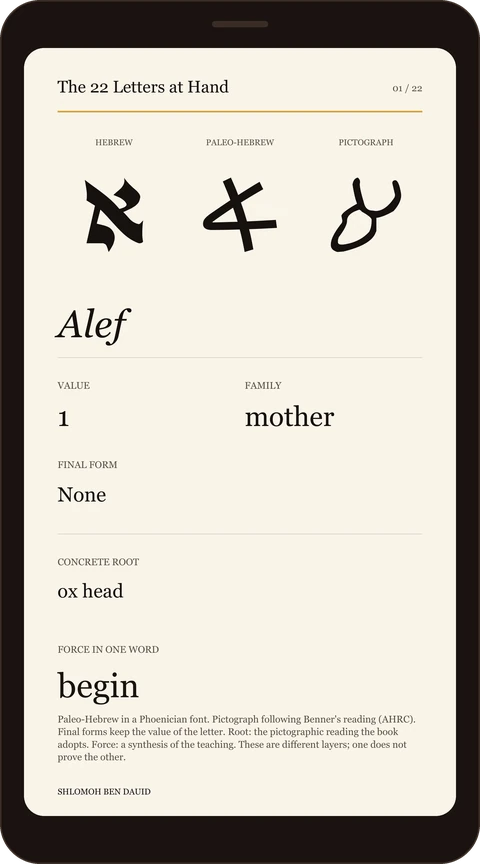
Alef card from the bonus The 22 Letters at Hand, on a phone screen

Bonus included (The 22 Letters at Hand)

A reference pack to keep beside the book, at no extra cost:

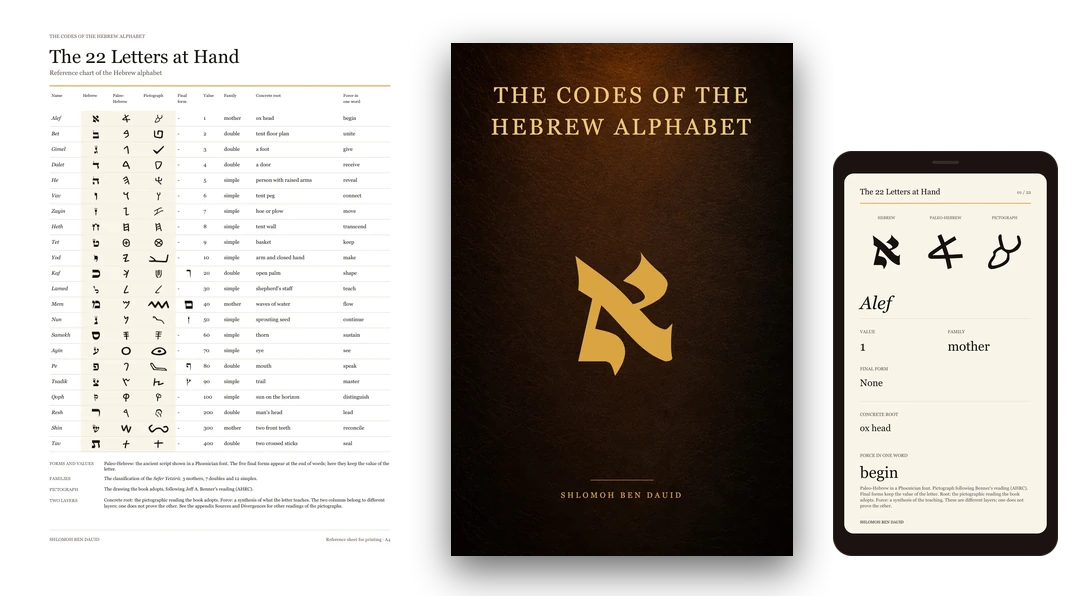
  • a vector chart of the twenty-two letters, ready to print on a single sheet;
  • a PDF with twenty-two cards sized for your phone, for a quick look.

The chart puts together the scripts, the pictograph, the value, the family and the meanings of each letter. It gathers in one place what the book develops chapter by chapter; it doesn't replace the full explanation.

Who this book was written for

For the reader who wants to study what the letters mean and needs a place to start. For the one who already follows explanations, but would rather have a text to mark up, print and come back to. And for the one who arrives at the alphabet through their own name or through the study of Scripture, and wants the reading of the tradition with its sources in plain sight.

The book is not a language course. It doesn't teach you to speak, write or read Hebrew with fluency. Nor does it use gematria as fortune-telling, turn your name into a diagnosis, or promise a personal change after the last page.

It teaches how the tradition reads each letter: its form, its number, its words, its two poles and the question it puts to the person reading.

Special offer of the first edition

The ebook cover, the twenty-two letters on one sheet, and a bonus card on a phone screen

The regular price of the ebook will be $14.90. During the special launch promotion of the first edition, you pay only $9.90. You save $5.00 (33%).

You pay once. There's no subscription and no recurring charge.

The ebook and the bonus reach you immediately after the payment is confirmed. And you get a 7-day guarantee through the platform.

Buy the ebook for $9.90

You'll be taken to the platform's secure checkout to complete the purchase.

Frequently asked questions

Do I need to know Hebrew to follow the book?

No. The Hebrew words appear with a translation and an approximate pronunciation. The structure repeats across the twenty-two chapters so you know where you are and can pick the study back up without any prior knowledge.

Does the ebook teach me to read or speak Hebrew?

No. This is a study of the form, the number, the words and the meanings the tradition gives the letters. It can widen your understanding of the alphabet and Hebrew terms, but it doesn't replace a language course.

Do I need to follow a religion to read it?

No. The book presents its sources and explains the reading of the tradition without asking the reader to belong to a religion. You can study the content, compare the interpretations and decide what you make of them.

Does the book use gematria to predict the future?

No. The numeric values are part of the study of the letters, but they aren't used as fortune-telling. The book also doesn't promise to reveal destiny, a whole personality or future events.

What will the book say about my name?

Every chapter explains the potential and the warning tied to the presence of that letter in a name. For names originally written in the Latin alphabet, the reading depends on the transliteration chosen. The result works as an application and as a question to think about, not as a diagnosis of who you are.

Is the material physical or digital?

The product is digital. You get the ebook in PDF, with 154 pages, and the bonus The 22 Letters at Hand. No printed book will be shipped.

Can I read it on my phone or print it?

Yes. The ebook is laid out for reading on screen, and you're free to print it. The bonus includes a chart of the twenty-two letters to print on a single sheet and a PDF with cards sized for your phone.

How will I get the ebook and the bonus?

Once your payment is approved, the platform sends a message to the email address you gave at checkout, with the link to download the files.

Is access released right away?

The material is released as soon as the payment is confirmed. How long the approval takes depends on the payment method you choose at checkout.

Is there a monthly fee or a recurring charge?

No. You pay the $9.90 once.

What if I buy it and find the book isn't for me?

You have a 7-day guarantee. Request the refund through the platform.

What do I do if I can't find the material?

Look for the platform's message in your inbox, in the spam folder and in the Promotions tab of the email you used for the purchase. If you still need help, write to [email protected].